


Symbolic Wedding Ceremonies in Spain: The Stress-Free Route for Foreign Couples
Somewhere between the dream of getting married in Spain and the reality of Spanish paperwork, a lot of couples quietly give up on the idea. And that’s a shame, because there’s a route through it that almost nobody explains properly: the symbolic ceremony.
It’s not a loophole, and it’s not a lesser version of «the real thing.» For most international couples, it’s simply the smartest way to have the wedding they actually pictured without spending a year exchanging emails with a civil registry office.
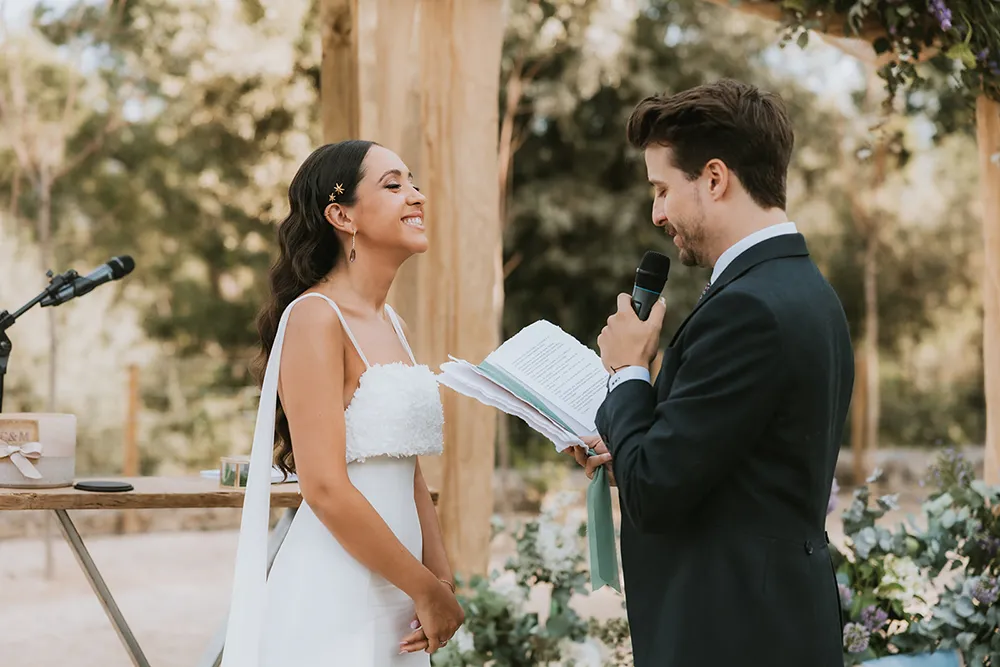
Couple exchanging vows outdoors at Huellas del Tiétar, Sierra de Gredos. Author: Iris Vega
Why is it so complicated to legally marry in Spain as a foreigner?
Here’s the part most couples don’t find out until they’re already deep into planning: in Spain, a legally binding civil marriage generally requires that at least one partner be a Spanish citizen or a legal resident, typically with at least two years of registered residency («empadronamiento»). If neither of you fits that description, the legal route runs through an official process called the “expediente matrimonial,” the Civil Registry’s procedure for checking that there’s no legal impediment to your marriage.
And that process asks for a lot: apostilled birth certificates, certificates of «no impediment» from your home country, civil-status certificates, sworn Spanish translations of every document, and, if either of you has been married before, the full paper trail of that too. Processing can take anywhere from a couple of months to well over a year, and the exact requirements can vary from one Civil Registry office to another, which makes it almost impossible to plan around with any certainty.
None of this is a flaw in the system, it exists to prevent fraud, and it works reasonably well for residents. It’s just not designed with a couple flying in from London, Chicago or Sydney for a single weekend in mind.
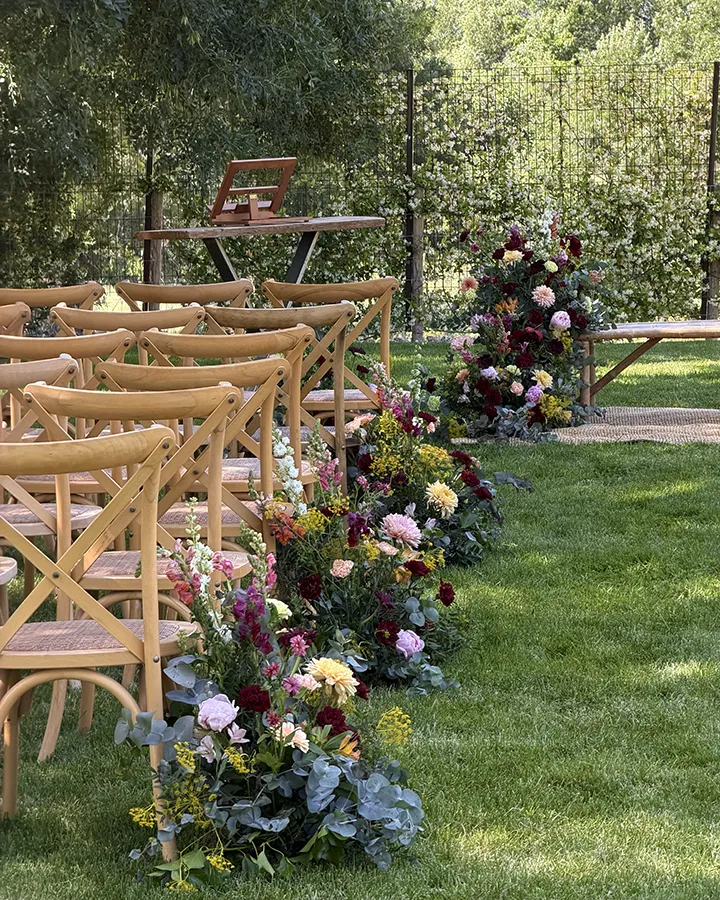
Detail of the preparation of a civil ceremony, Valle del Tiétar
So what exactly is a symbolic ceremony — and why do so many international couples choose one?
A symbolic ceremony is, in every way that matters to you and your guests, your wedding. Vows, rings, readings, the walk down the aisle, the tears, the applause, all of it happens exactly as you imagine it. The only difference is a technical one: it isn’t the document that registers your marriage with the Spanish State.
It helps to separate two things that we tend to lump together: the marriage (the legal contract, which in most countries can be completed in minutes with a signature) and the wedding (the ceremony, the vows, the celebration, everything that actually feels like getting married). A symbolic ceremony lets you keep that second part exactly as you want it, in the place you want it, while handling the legal contract wherever it’s simplest: usually back home, before or after your trip to Spain.
This is precisely why symbolic ceremonies have become the standard, not the exception, for international couples marrying in Spain. It isn’t about avoiding commitment to the legal side; it’s about not letting bureaucracy designed for residents dictate the shape of your wedding day.
· Before or after? The sequencing decision nobody walks you through
Most guides mention, almost in passing, that you can do the legal paperwork «before or after» your ceremony in Spain. But this is actually a real decision worth thinking through, because each order changes how your wedding day feels.
Marrying legally before you travel means the date of your symbolic ceremony and your legal anniversary are one and the same, which matters to a lot of couples emotionally, and avoids any awkward «wait, are you actually married yet?» conversations with curious guests. Marrying legally afterwards, on the other hand, keeps your day in Spain as the single, undivided emotional centerpiece, nothing has happened yet, this is the moment, full stop. Neither option is more «correct.» It’s worth a conversation between the two of you about which version of the story you’d rather tell for the rest of your lives.
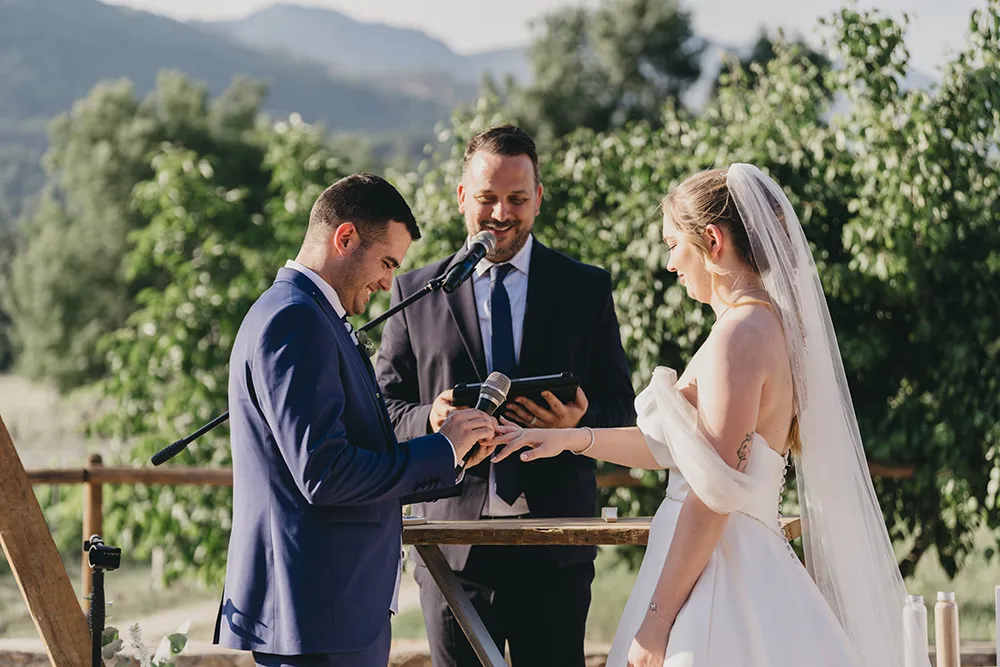
Officiant and couple during a ceremony, Huellas del Tiétar
What can you actually do with a symbolic ceremony that you couldn’t do with a legal one?
More than most couples expect, and this is where the format stops being a workaround and starts being an upgrade.
- Total freedom over location.
No registry office, no church requirement, your ceremony can happen wherever feels right: outdoors on the grass, in a converted granary, framed by mountains, anywhere a legal ceremony in Spain simply couldn’t take place.
- A script that’s entirely yours.
Vows, readings, rituals, structure, music, the language it’s conducted in, every line can be written around your story rather than fitted into a legal template.
- Freedom to blend cultures, languages and traditions.
A symbolic ceremony can move between English and Spanish, mix family customs from both sides, or include rituals from different backgrounds in the same service, something a strictly civil or strictly religious format usually can’t accommodate.
- No waiting on anyone else’s calendar
Once the legal side is settled in your own country, on your own terms, in your own language, surrounded by familiar institutions, your day in Spain is entirely about the celebration, with nothing pending.
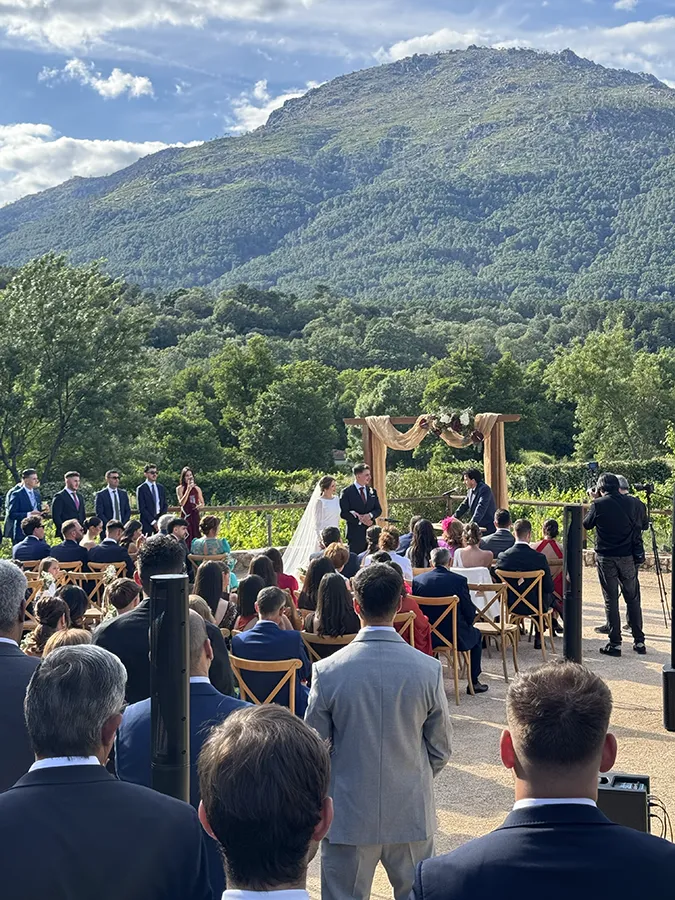
Guests seated and couple ready for an outdoor ceremony with Sierra de Gredos as a backdrop, Lanzahíta, Ávila
Who actually leads a symbolic ceremony and what can it look like?
This is the part that surprises a lot of English-speaking couples: a symbolic ceremony doesn’t require a judge, a priest or any official authority, because it carries no legal weight of its own. It can be led by a professional celebrant, a master of ceremonies, or even someone close to you, whoever can bring the warmth and the words that match the moment.
And because there’s no legal script to follow, the ceremony can take almost any shape you choose. Couples weave in rituals like the unity candle, a sand ceremony blending two colors into one vessel, the exchange of arras (wedding coins, a beautiful Spanish tradition), handfasting, or the hilo rojo (the red thread said to connect two people whose meeting was always meant to happen). None of these require religious or civil authority. They simply require someone to hold the moment well.
It’s worth saying plainly: this isn’t a smaller version of a «real» wedding. For most couples who choose it, it’s the version that finally feels like theirs.
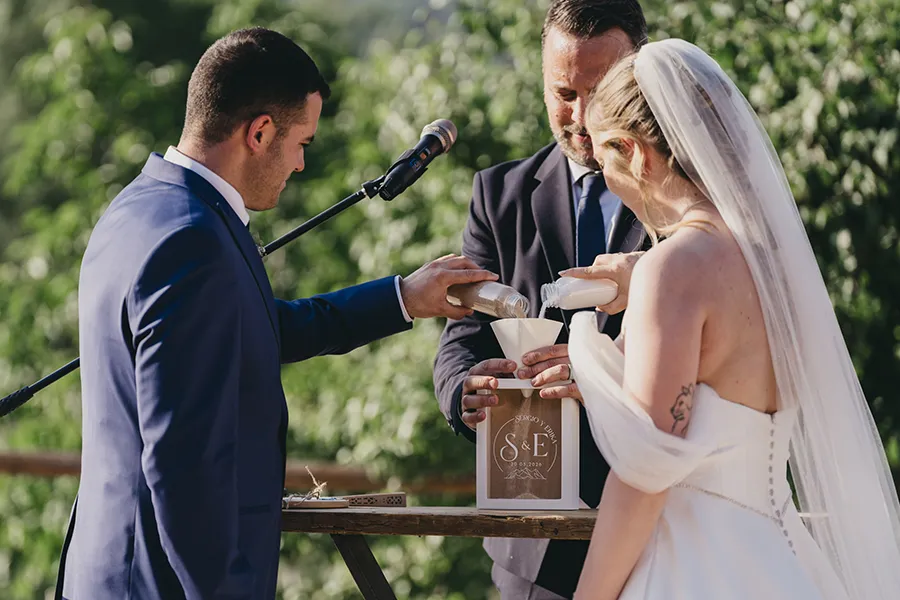
Close-up of a ritual moment during a ceremony at Huellas del Tiétar
Why choose somewhere like the Tiétar Valley instead of the usual coastal spots?
Search for weddings in Spain and you’ll mostly find the same handful of places: Ibiza, the Costa Brava, Mallorca, Barcelona rooftops. They’re beautiful, and they’re also exactly what every other couple is picturing.
The Tiétar Valley, at the foot of the Sierra de Gredos in the province of Ávila and very close to Madrid, is a different kind of Spain: quieter, slower, closer to how people here actually live. It’s the side of the country that doesn’t usually make it into wedding inspiration boards: stone villages, oak groves, mountain light, vineyards, a rhythm of life that hasn’t been built around tourism. For a ceremony built entirely around the freedom to choose your own setting, this is precisely the kind of place that freedom was made for, and it’s only about 1 hour and 45 minutes from Madrid and its international airport, so reaching it is far simpler than it looks on the map.
How does Huellas del Tiétar fit into all of this?
We’ve been hosting weddings since 2022, and a good number of the couples who choose us are exactly the ones this article is written for: couples who want a ceremony that feels entirely their own, without Spanish bureaucracy shaping their plans.
We offer a few different settings for the ceremony itself: an old granary with history of its own, the lawn beside the restaurant with the Sierra de Gredos as a backdrop, or a fully adaptable space that can be shaped around your vision, and our team is used to working alongside celebrants and planners to help a symbolic ceremony come together exactly as imagined. And because we run our own kitchen, with our own chef and a stable team behind it, the celebration that follows the ceremony carries the same level of care: no external catering, no compromises, just a menu that tells your story.
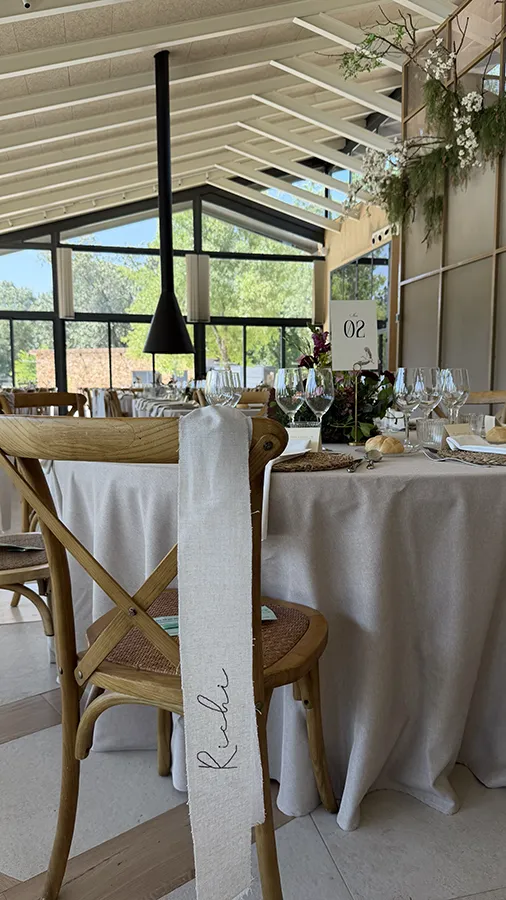
Wedding celebration at Huellas del Tiétar’s restaurant
Frequently asked questions about symbolic weddings in Spain
PLAN YOUR CEREMONY AT HUELLAS DEL TIÉTAR
We’re in Lanzahíta, in the heart of the Tiétar Valley, at the foot of the Sierra de Gredos, about 1 hour 45 minutes from Madrid and its international airport. We’ve been hosting weddings since 2022, with settings made for ceremonies that are entirely your own, and a kitchen of our own to carry that same care through to the celebration.
If you’re picturing a symbolic ceremony in a part of Spain that still feels like Spain, get in touch or come and see it for yourselves.
We’ll be here, waiting for you.

