


The Complete Guide to a Destination Wedding in Spain in 2028
For a long time, Italy owned the destination wedding conversation. Tuscany, the Amalfi Coast, Puglia, Lago di Como… Beautiful, no question. But the couples who’ve started looking at Spain in the last few years have discovered something those postcards don’t show: amazing food, interesting wines, a generous sense of celebration, and venues that haven’t yet been photographed to exhaustion.
Planning a destination wedding in Spain for 2027 or 2028 is a different kind of decision from booking a beach resort wedding or a city hotel. It requires earlier planning, different legal logistics, and a clear idea of what you want the experience to feel like, not just on the day, but for the guests who’ve travelled to be there. This guide covers everything you actually need to know.
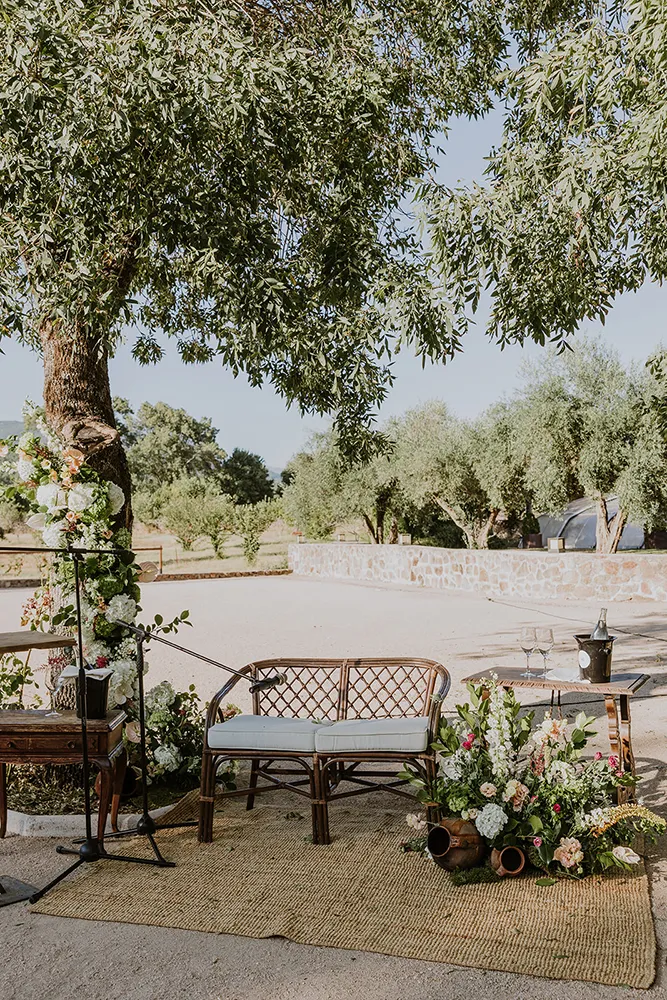
Wedding ceremony set up under the trees, olive trees and the Sierra de Gredos mountain range in the background. Lanzahíta, Ávila, Spain
Why Spain — and why 2028 is the right moment
Spain has always had the ingredients for exceptional weddings: the climate, the food culture, the wine, the architecture, the landscape. What’s changed in recent years is that couples planning destination weddings have started to look beyond the obvious coastal options and discovered the interior of the country (the wine regions, the mountain estates, the centuries-old farmhouses with working vineyards) and realised that what Spain offers outside the tourist circuit is in many ways more interesting than what’s inside it.
2028 is a particularly good moment to book. The best destination wedding venues in Spain fill up on the same timeline as their Italian or Portuguese equivalents, 14 to 18 months in advance for premium dates, but the awareness among international couples is still lower, which means the choice of exceptional venues is wider than it will be in a few years. The couples who book in 2026 for 2028 are making a good decision while there’s still room to make it.
One practical note that often surprises couples: Spain is almost always more affordable than the equivalent experience in Tuscany or the Algarve. A comparable rural estat (own kitchen, own wine, mountain scenery, full exclusivity) typically comes in at significantly lower cost in Spain, without any meaningful trade-off in quality.
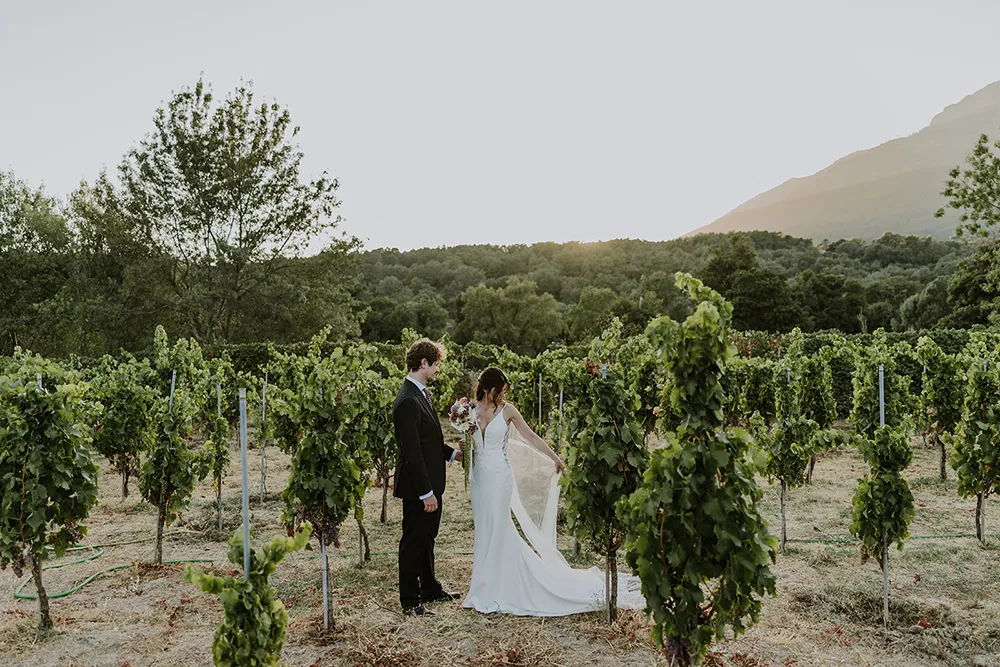
Golden hour at the vineyard of Huellas del Tiétar winery: warm light, Sierra de Gredos in the background. Lanzahíta, Ávila.
Choosing your region: what Spain’s wedding geography actually looks like
Spain is large and genuinely diverse, and the destination wedding experience varies considerably depending on where you celebrate. The main options international couples consider:
· Andalusia
Haciendas, flamenco, olive groves, white villages. The quintessentially Spanish aesthetic. Summers are very hot (regularly above 40°C in July and August), which pushes weddings toward spring and autumn. Seville and Granada are the main hubs, with direct flights from most European cities.
· Costa Brava and Catalonia
Coastal cliffs, modernist architecture, excellent gastronomy. Strong visual identity, strong competition for the best venues. Barcelona is one of Europe’s best-connected airports. The luxury end of the market here is genuinely luxurious — and priced accordingly.
· The Balearic Islands
Mallorca, Ibiza, Menorca. Fincas with pools, sea views, outdoor ceremonies. Peak season is crowded and expensive; shoulder season (May, October) is more manageable. Guest accommodation is easy to organise given the hotel infrastructure.
· Castile and the Madrid hinterland
The least explored option for international couples, and in some ways the most interesting. Two hours from Madrid in any direction, the landscape shifts from the Castilian plateau into mountain ranges with wine country, medieval towns and working estates that have been producing food and wine for centuries. The Sierra de Gredos (less than two hours southwest of Madrid) offers exactly this: wild mountain scenery, some of Spain’s most characterful small-production wines, and rural venues that feel genuinely rooted in their territory rather than purpose-built for weddings. For couples who want Spain to feel like Spain, not like a carefully art-directed version of it, this is the region to consider.
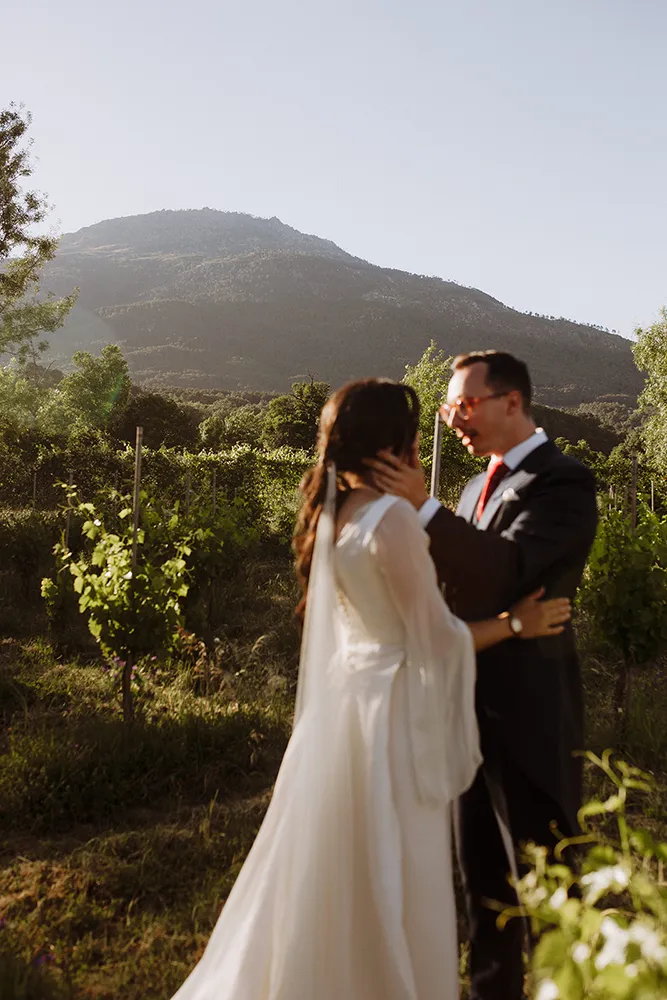
Valley landscape with vineyards and Sierra de Gredos mountains. Valle del Tiétar, Ávila
The legal side: how marriage actually works in Spain for foreign couples
This is the question couples always ask first, and the answer is simpler than it sounds once you understand the options.
· Civil marriage in Spain
Spain allows foreign nationals to marry civilly in the country, but the process requires a significant amount of documentation: birth certificates, proof of single status, and in many cases apostilles and official translations. The process is managed through the local civil registry and the couple’s consulate. It’s entirely doable, but it takes time (typically three to six months of administrative preparation) and requires a local notary or registry official to be present at the ceremony.
· The symbolic ceremony route (how most destination couples do it)
The overwhelming majority of international couples who marry in Spain opt for a different approach: they handle the legal marriage at home, at their local registry office, usually before or after the trip, and celebrate a symbolic ceremony in Spain. A symbolic ceremony has no legal requirements, no paperwork, no official presence. The celebrant, the vows, the structure and the content are entirely yours to design. The day is your celebration; the legal formality is a separate, quiet admin step that happens elsewhere.
This is not a compromise or a workaround, it’s what most couples who’ve thought it through choose, because it gives them complete freedom over the ceremony without the administrative complexity. Many couples find the registry marriage a surprisingly intimate moment in itself: just the two of them, a couple of witnesses, a brief formality, done. The celebration in Spain is where the day lives.
· Our honest recommendation
Unless you have a specific reason to want the legal ceremony in Spain, go symbolic. Spend your energy on the celebration, not the paperwork. If you want to marry legally in Spain, talk to a local gestor (administrative consultant) who handles wedding documentation, they’ll save you months of confusion.
When to get married in Spain in 2028: seasons, timing and the ceremony hour
· The best seasons
Spring (late April through June), summer (July) and autumn (September through October) are Spain’s wedding seasons for good reason: the temperatures are comfortable almost everywhere, the light is extraordinary, and the landscape is at its best. Summer (July and August) works well in the north and in inland mountain areas where altitude keeps temperatures reasonable; in the south and at sea level, summer weddings require more planning around the heat. Winter weddings are a minority but have their own charm: fewer crowds, lower prices, a different quality of light.
· In the Valle del Tiétar specifically
The Sierra de Gredos has a microclimate that makes it genuinely comfortable throughout summer: the valley sits at altitude, air circulates well, and the nights are cool even in August. Late September and October are particularly spectacular — the vineyards turn, the light softens, temperatures sit between 18 and 26°C. For guests travelling from northern Europe or North America, it feels like a gift.
· The ceremony hour: the most important timing decision you’ll make
Spanish weddings don’t start at 2pm. If you’re getting married in Spain and you schedule your ceremony for midday, you’re fighting the country’s own logic. The Spanish ceremony time is 7pm — sometimes 7:30. The light at that hour is unlike any other time of day: golden, long, angled. The aperitivo runs from 8 to 10. Dinner starts at 10 or 10:30. Dancing goes until 3 or 4am.
Tell your guests in advance. They’ll need to have a proper lunch on the day. Once they’ve recalibrated, the late timing stops feeling strange and starts feeling like the evening was designed for people to actually enjoy themselves, which it was.
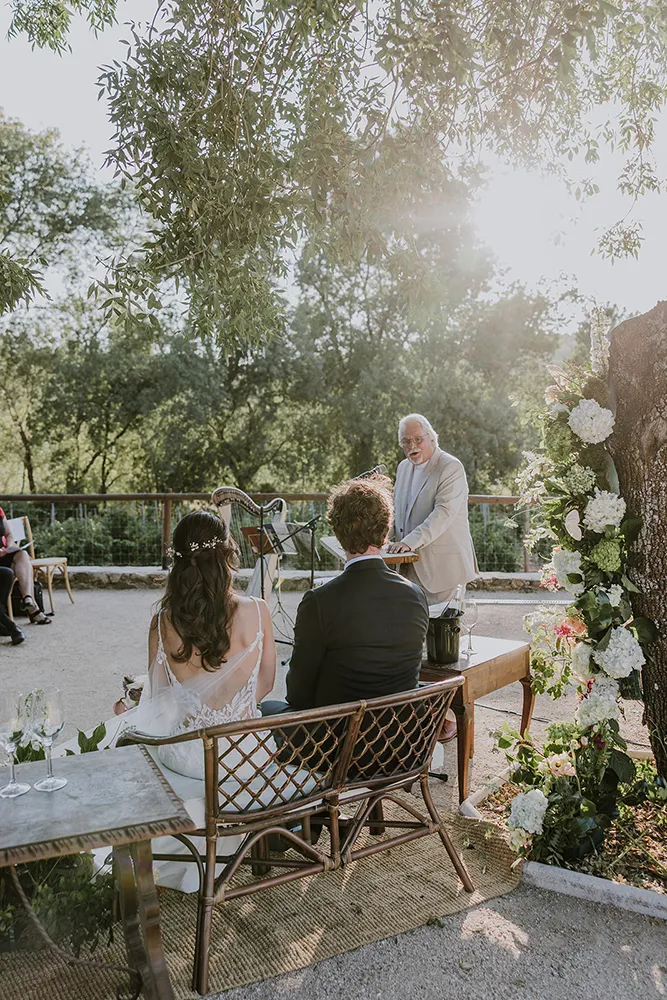
Ceremony at golden hour at Huellas del Tiétar: couple at the outdoor space, Sierra de Gredos in the background, warm light. Lanzahíta.
Planning from abroad: the vendors you need and how to think about them
· Your venue is your anchor — choose it first
Everything else in a destination wedding organises around the venue. The date comes from the venue. The guest logistics come from the venue’s location. The catering situation, whether you need a separate caterer or whether the venue handles it, shapes your entire vendor list. Choose the venue before you book anything else, and choose it with enough time to build the rest of the planning around it comfortably.
· The enormous advantage of a venue with its own kitchen
For destination couples especially, a venue with an in-house kitchen and chef is a significant simplification. It means one fewer vendor to research from abroad, one fewer contract to negotiate in a language you may not speak, one fewer coordination point on the day. It also typically means better food. A kitchen that belongs to the venue has been preparing food in that space for years, understands its rhythms and its logistics, and has a quality record you can actually check.
· Photographer: book earlier than you think
The best wedding photographers working in Spain, particularly those covering rural, countryside and wine-country weddings, are booked 18 months or more in advance. This is not an exaggeration. If you have a photographer in mind, contact them at the same time as the venue, not after. If you need recommendations, the venue team will have worked with photographers they trust and can point you toward.
· The coordinator question
Destination couples often wonder whether they need a wedding planner on the ground. The answer depends largely on what the venue provides. A venue with an experienced, dedicated coordination team that accompanies you from the moment of booking may make an external planner redundant. A venue that simply provides the space and the catering, leaving the rest to you, makes one essential. Ask the venue directly: who manages the day-of logistics? Who is your contact from booking to the last guest leaving?
Your guests’ experience: the logistics that make or break a destination wedding
A destination wedding asks something of your guests (travel, time, expense). The couples who handle this best are the ones who’ve thought about it from the guests’ perspective, not just their own.
· Getting there
Madrid Barajas (MAD) is one of Europe’s best-connected airports, with direct flights from most major cities in North America, Latin America, and across Europe. From Barajas, the Valle del Tiétar is 1 hour 45 minutes by road, no toll. For guests arriving by train, Talavera de la Reina (35 minutes from Huellas del Tiétar) is served by high-speed rail from Madrid. The logistics are straightforward once guests know the route.
· Accommodation
This is the most common logistical challenge for rural destination weddings: the ceremony and celebration are in a beautiful, remote-feeling location, but guests need somewhere to sleep..
Looking ahead: our boutique hotel is opening on the estate in late 2027, built among the centuries-old olive grove that surrounds the finca. From 2028, guests will be able to stay on-site, making the full wedding weekend experience — Friday arrival, Saturday celebration, Sunday brunch — possible without leaving the property. For couples who want to plan around that, 2028 is the year.
· The guest information document: send it three months out
International guests need more information than local ones. A few months before the wedding, send a document that covers: how to get to the venue (with map links and driving directions), nearest airports, accommodation recommendations at different price points, what to expect from a Spanish wedding timeline, and any local experiences worth planning around the trip. This single document reduces the number of questions you’ll receive tenfold and makes your guests feel genuinely looked after.
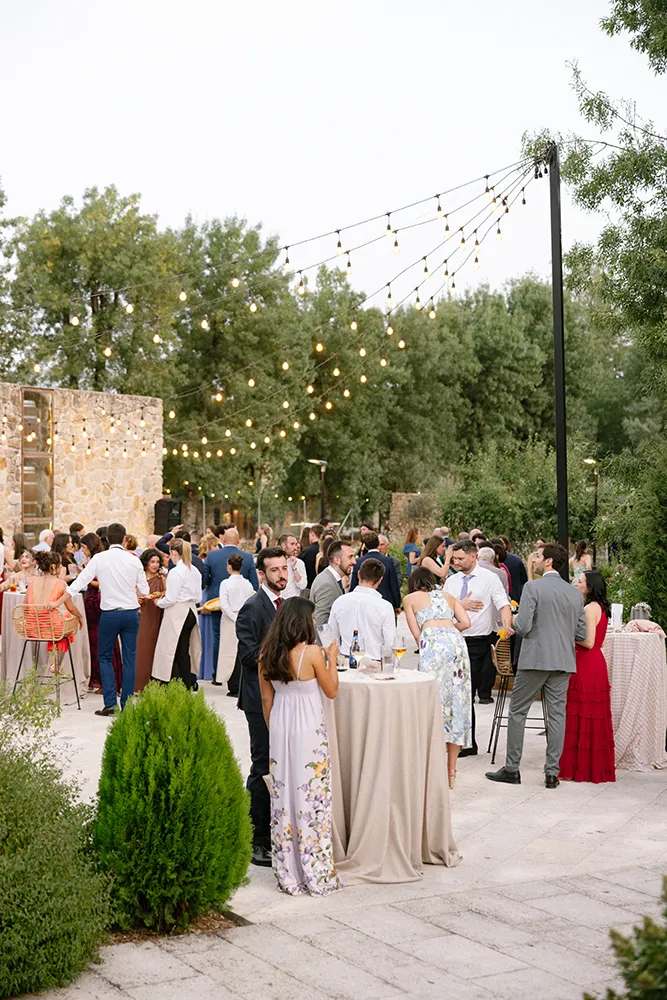
Cocktail hour at Huellas del Tiétar: guests under the trees, food stations, late afternoon light. Lanzahíta, Ávila.
What a destination wedding at Huellas del Tiétar actually looks like
Huellas del Tiétar is a rural estate in Lanzahíta, in the Valle del Tiétar, at the southern foot of the Sierra de Gredos. We’ve been building it since 2013: a working winery, a restaurant with its own kitchen and chef, event spaces designed for the way we actually celebrate here, and a landscape that has been shaping this place for longer than any of us.
A wedding here has a specific shape. The ceremony takes place in one of four possible spaces, all of them with the sierra as the backdrop. When the ceremony ends, guests move to the cocktail hour under the shade of trees that have been growing for decades, with food stations from our own kitchen: a live ham carver, artisan cheese from our own creamery, hand-made croquettes, craft beers, a Mexican corner. A live band or a live art station if you want them. Then the salon for the banquet, air-conditioned and with its own character, and a night that ends when nobody wants to go home, under a sky with no light pollution and the mountains in silhouette.
The wines at your wedding will be ours: D.O.P. Cebreros wines made from grapes grown on almost-centenary vines on the Sierra de Gredos. You can taste and select them as part of the planning process. The food will be cooked by Jorge García, our chef and a Castile and León Master Roaster with two Repsol Suns and more than twenty years in this kitchen.
We work with a small number of weddings each year, by choice. Not because we can’t do more, but because doing fewer means doing each one properly.
Frequently asked questions: destination weddings in Spain
No. Our team works in English, and all planning communication (emails, calls, proposals, contracts) can be handled in English. On the day itself, we coordinate everything so that couples and guests who don’t speak Spanish never need to.
Yes, though most international couples choose a symbolic ceremony at the finca and handle the legal formalities at home. If you want to marry legally in Spain, we can connect you with a local gestor who handles the documentation process for international couples. We’re happy to discuss both options and help you decide what makes sense for your situation.
1 hour 45 minutes by road, with no toll on the recommended route. Madrid Barajas (MAD) has direct connections from most major cities worldwide, making it a practical arrival point for international guests. There’s also a train to Talavera de la Reina, 35 minutes from the finca.
The Valle del Tiétar has a good range of rural accommodation within 15 minutes of the finca. We share a curated list with all couples so their guests have reliable options at different price points. Our boutique hotel, opening on the estate in late 2027, will make on-site accommodation available for weddings from 2028 onwards.
A destination wedding at Huellas del Tiétar is typically more affordable than a comparable experience at a Tuscan estate or an Alentejo quinta, without meaningful trade-offs in quality. Spain’s rural interior is genuinely underpriced relative to the experience it offers, something couples who’ve compared carefully tend to discover for themselves.
Contact us. We’ll confirm availability for your date, answer your questions, and if dates and vision align, arrange either a visit to the finca or a video call so you can meet the team and see the space before committing to anything.
PLANNING A DESTINATION WEDDING IN SPAIN FOR 2028?
Huellas del Tiétar is a rural wedding estate in Lanzahíta, in the Sierra de Gredos, 1h 45 from Madrid. Own kitchen, own winery, four ceremony spaces, and a team that has been doing this with care since 2013.
Get in touch to check availability and arrange a visit or a video call. We’re happy to answer every question you have before you decide anything.
We look forward to hearing from you.

